Monday, June 20, 2011

ANKLE INSTABILITY (SEVERE SPRAINS) - DR KHAIRUL FAIZI MOHAMMAD


Picture during surgery showing a torn ligament of the ankle

stress xrays to show ankle instability

Ankle instability is a condition characterised by the ankle "giving way" or feeling unstable particularly when walking on uneven surfaces. The stability of the ankle is supported by ligaments on the outer aspect of the foot named the anterior talo fibular ligament and the calcaneo-fubular ligament. These ligaments arise from the fibular bone (next to the shin) and the to talus and calcaneum (heel) respectively. Ankle sprains damage these ligaments to varying degrees.
SYMPTOMS
Instability is characterised by the foot giving way. The feeling that the ankle is not reliable and loose. It may also be associated with pain and swelling to the outer aspect of the ankle.
CAUSES
Chronic instability of the ankle is the result of the ligaments not healing after a severe sprain or more commonly, repeated sprains. This is a very common occurence during sporting activities such as football, futsal, rubgy and badminton. These injuries may range from stretching of the ligament to complete tears.
When this occurs, small nerve in the ligament are damaged. This does not allow the brain to sense instability. Therefore the surrounding muscles are not reacting to the unstable condition. With this, you are more prone to strains and repeated trauma to your ankle.
DIAGNOSIS
If your ankle feels unstable or you have sustained repeated ankle sprains, please consult you Consultant Foot and Ankle Surgeon for a full assessment.
The diagnosis is usually achieved simply from the history and examination. The clinical examination will show that the ankle in unstable (positive anterior drawers test). The foot is able to be drawn forward on the ankle joint beyond normal. The ATFL and CFL tendon may be tender.
Stress radiographs (xrays) are best to demonstrate that the ankle joint is unstable. This is best done under anaesthesia. An MRI may also be taken if there is a suspicion of cartilage damage to the ankle joint.
TREATMENT
Treatment is dependant of the level of one activity.
1. Simple ankle sprains are treated with physiotherapy. This is to retrain the ankle to gain its nerve functions again. This also allows the surrounding muscles to strengthen.
2. Surgery may be of 2 types:
a) Damaged ligaments maybe tightened and reattached to the bones. This is a very successful procedure and is usually performed in active individuals and athletes.
b) If all has failed, tenodesis surgery can be performed. This involves ligament reconstruction using a tendon harvested from another part of the body. This is very durable but it will lead to stiffness of the ankle.
Should you have any of the symptoms above, please consult your Consultant Foot and Ankle Surgeon
Dr Khairul Faizi Mohammad
Consultant Foot and Ankle Surgeon
Kuala Lumpur Foot Ankle Clinic

Pantai Hospitals
(CHERAS (HQ), KUALA LUMPUR, AMPANG)

Sunday, June 12, 2011

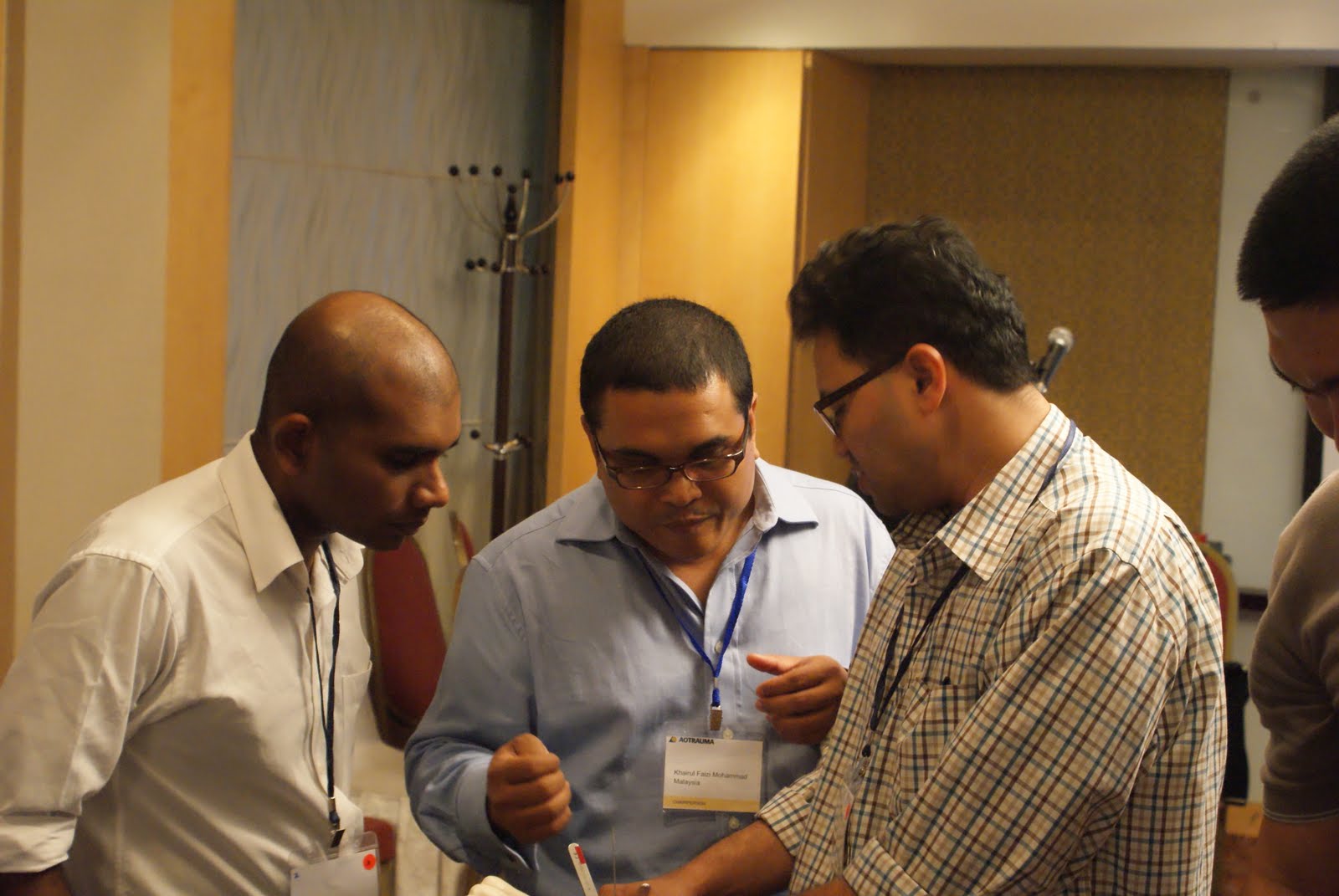
KUALA LUMPUR FOOT ANKLE CLINIC (KLFAC) - AOTrauma Foot and Ankle Course 2011 (Kuala Lumpur) - Dr Khairul Faizi Mohammad

Dr Khairul Faizi Mohammad (KLFAC, Malaysia - centre)

Dr Les Grujic (Australia) centre

Dr Andrew Beischer (Australia) demonstrating.

Participants and Faculty members

KLFAC would like to congratulate Dr Khairul Faizi Mohammad on chairing and organizing the world accreditted AOTrauma Foot and Ankle Course in Kuala Lumpur on the 6th of June til the 8th of June 2011.
This course was over subscribed and attended by surgeons from Malaysia, Singapore, Indonesia, Thaiand, Myanmar, India and Australia. Speakers at this course included Dr Les Grujic (Australia), Dr Andrew Beischer (Australia), A/Prof Inderjeet Singh (Singapore), Dr Chong Keen Wai (Singapore) and Dr Khairul Faizi Mohammad (KLFAC, Malaysia).

Monday, March 21, 2011

DR KHAIRUL FAIZI MOHAMMAD: FLAT FEET (Kosmo - Malay version)


The end of the first quarter of the year is ending and Foot and Ankle Problems has been relatively quiet. The Kuala Lumpur Foot Ankle Clinic, headed by Dr Khairul Faizi Mohammad has been very busy with clinical and academic activities related to foot and ankle surgery. We will be updating everyone with more information in the days to come. So as a start, this is a newspaper footage (in malay) on flatfeet and a patients account of his experience.


If you do have questions or suffer from flat feet, please consult you Consultant Foot and Ankle Surgeon.


Sunday, September 5, 2010

EXTRACORPOREAL SHOCKWAVE THERAPY (ESWT) FOR FOOT PROBLEMS - DR KHAIRUL FAIZI MOHAMMAD (KLFAC)


ESWT being applied to the insertion of the achilles tendon

Close up view


WHAT IS EXTRACORPOREAL SHOCKWAVE THERAPY (ESWT)?


ESWT is a non invasive surgical procedure that uses shockwaves to simulate the healing process in certain conditions of the foot such as achilles insertional tendinitis and plantar fasciitis. Extracorporeal means outside the body. This refers to the method in which the therapy is applied. There are no incisions. Patients benefit from no associated complications of surgery and it can be applied as an outpatient procedure.


WHO ARE THE CANDIDATES FOR EXTRACORPOREAL SHOCKWAVE THERAPY (ESWT)?

Candidates for ESWT are those in which conservative treatments for their condition have failed. Conservative treats for heal pain include non steroidal anti inflammatory medication, point specific steroid injections, insoles, stretching exercises and physical therapy.

Patients who suffer from bleeding tendencies or who are on medication that leads to bleediong tendencies are contraindicated for the treatment. Your Foot and Ankle Surgeon will determine whether this treatment is suitable for you.


WHAT TO EXPECT FROM THE TREATMENT?

ESWT is mainly done on an outpatient basis. Anti inflammatory medication is stopped 5 days prior to the treatment. Shockwaves are applied using a machine to the respective areas in various intensities. Treatment usually takes around 30 minutes to be performed. Treatment will be performed 3 to 5 times, on a weekly basis dependant on the response to treatment.


Do contact your Consultant Foot and Ankle Surgeon if you are interested in knowing more about this treatment.


Dr Khairul Faizi Mohammad
Consultant Foot and Ankle Surgeon
KUALA LUMPUR FOOT ANKLE CLINIC
(KLFAC)
Pantai Hospital Cheras
Pantai Hospital Kuala Lumpur
Pantai Hospital Ampang

Monday, August 9, 2010

DR KHAIRUL FAIZI MOHAMMAD (KLFAC) talks at BFM 89.9 on "BAREFOOT RUNNING"


left to right:

Pete Pereira, Dr Khairul Faizi Mohammad (KLFAC), Shazmin Shamsuddin (BFM89.9)


The debate on shod running and barefoot running has been going on for the pass 40 years. Dr Khairul Faizi Mohammad from the Kuala Lumpur Foot Ankle Clinic and barefoot runner Pete Perriera are interviewed by Shazmin Shamsuddin from BFM 89.9. Listen in to our discussion!


Monday, May 24, 2010

Kuala Lumpur Foot Ankle Clinic - Majlis Pelancaran Majalah i-Sihat - Dr Khairul Faizi Mohammad

Utusan Karya Sdn Bhd has recently launched a new health based magazine called i-Sihat (i-health) This magazine will feature interviews, health related articles and advice pertaining to various aspects in a persons health.


Our Dr Khairul Faizi Mohammad from the Kuala Lumpur Foot Ankle Clinic has been appointed as a member of the Advisory Panel to the magazine. Once again we would like to congratulate Dr Khairul on his appointment and we hope the knowledge given will be beneficial to our society.

Malaysian Foot & Ankle Society (MFAS)


We would like to congratulate Dr Khairul Faizi Mohammad from the Kuala Lumpur Foot Ankle Clinic (KLFAC) on his appointment as secretary at the inaugural meeting of the Malaysian Foot and Ankle Society on the 18th of May 2010.


This society has been inaugurated to cater for the growing interest in foot and ankle diseases amongst clinician in Malaysia.

Sunday, May 2, 2010

KOSMO! features Dr Khairul Faizi Mohammad from KLFAC

Dr Khairul Faizi Mohammad from the Kuala Lumpur Foot Ankle Clinic (KLFAC) featured in the newpaper KOSMO! on the 2nd of May 2010. Read the depiction of a patients experience from the incident to the treatment that was given. Click on the link below:

Wednesday, April 21, 2010

KUALA LUMPUR FOOT ANKLE CLINIC (KLFAC) and AOTrauma Asia Pacific (Malaysia)


Dr Khairul Faizi Mohammad of Kuala Lumpur Foot Ankle Clinic (KLFAC) has long been associated with the AO Foundation based in Davos, Switzerland. He has been part of the teaching faculty in various country such as India, Jordan, Saudi Arabia, Switzerland and Malaysia. Now known as AOTrauma, this organization is the leading non profit making, educational organization for orthopaedic surgery.


In its 50th year anniversary, the creation of AOTrauma, it has completed the niche of surgeons specialising in musculoskeletal trauma and disease, fracture and its subsequent complications and problems.


We are glad to announce that our Dr Khairul Faizi Mohammad has been elected to the Malaysian Council as AOTrauma Education Chairperson. Congratulations!

Sunday, April 11, 2010

KUALA LUMPUR FOOT ANKLE CLINIC (KLFAC) AND MALAYSIAN ASSOCIATION OF SPORTS MEDICINE (MASM)

Dr Khairul Faizi Mohammad of Kuala Lumpur Foot Ankle Clinic (KLFAC) was elected to the council of the Malaysian Association of Sports Medicine (MASM) at the biennial general meeting on 10 April 2010 at the Royal Selangor Club in Kuala Lumpur.

Sunday, April 4, 2010

KUALA LUMPUR FOOT ANKLE CLINIC - VIETNAM TRAUMA SEMINAR - DR KHAIRUL FAIZI MOHAMMAD


Dr Khairul Faizi Mohammad of Kuala Lumpur Foot Ankle Clinic operating on a patient in Military Hospital 7a in Ho Chi Minh City, Vietnam.


Dr Khairul Faizi Mohammad of Kuala Lumpur Foot Ankle Clinic (centre) with sugeons from Cambodia.


Vietnam Orthopaedic Surgeons who participated in the Vietnam Trauma Seminar


Dr Khairul Faizi Mohammad of Kuala Lumpur Foot Ankle Clinic delivering one of his lectures at the Vietnam Trauma Seminar.


Dr Khairul Faizi Mohammad of Kuala Lumpur Foot Ankle Clinic, reviewing the patient, radiographs and planning for surgery at Military Hospital 7a, Ho Chi Minh City, Vietnam.

Dr Khairul Faizi Mohammad of Kuala Lumpur Foot Ankle Clinic (KLFAC) was invited to share his expertise with orthopaedic surgeons from Vietnam and Cambodia on the 26th of March 2010. The event "Vietnam Trauma Seminar" was hosted by the Vietnamese Orthopaedic Association.

Participants included senior orthopaedic surgeons from Ho Chi Minh City, Hanoi, the provinces and also Cambodia.

Three lectures and discussions were delivered in the morning and live surgery was conducted in Military Hospital 7a. This was the first time that a non Vietnamese Surgeon was allowed to enter and perform surgery in the military hospital.

The knowledge exchange was a phenominal experience.

Should you have any questions regarding signs and symptoms of an orthopaedic nature, do contact your orthopaedic surgeon.

Dr Khairul Faizi Mohammad

BMedSci(Hons), BMBS(Nottingham), MRCS(Edinburgh), MSOrth(UKM)

Consultant Orthopaedic, Foot and Ankle Surgeon

Kuala Lumpur Foot Ankle Clinic (KLFAC)

Pantai Hospital Cheras and Ampang


join us on Facebook:

Thursday, March 11, 2010

ADULT ACQUIRED FLAT FOOT (PES PLANUS) - DR KHAIRUL FAIZI MOHAMMAD


Pre and post operative radiographs of a patient with Flat Feet. The radiographs show a dorsilateral peritalar subluxation (the arrows). The radiograph of the right shows the reconstructed deformity with the midfoot fusion bolt and x-plate.


Lateral view of the right foot


Clinical pictures of flat foot with dorsilateral peritalar subluxation


Post operative pictures with the foot arches reconstructed


INTRODUCTION


Flat foot is a very common problem and for many, it may not cause any problems at all. Problem start to occur when the deformity worsens and leads to malalignment of the axis of the limb leading to imbalances in the ankle, knees, hips and back.


CAUSES


Flat foot can be congenital or acquired during the adult life. The shape of the foot is determind by many factors such as genes, bones, muscles, supporting tendons and ligaments. Any pathology or injury to these structures can lead to flat foot.


PROBLEMS WITH FLAT FOOT


A foot that is flat is structurally at a disadvantage compared to a normal one. Although it may be without any symptoms of pain, the altered mechanics leads to increased stresses and strains due to normal day to day load.


Two common causes of adult acquired flat foot are:


1. tibialis posterior dysfunction


This is due to inflammation and degeneration of the tibialis posterior tendon. This leads to gradual pain, swelling and flattening of the arches of the foot (flat foot). It is often missed and may lead to serious permanent disability.


2. osteoarthritis


Osteoarthritis of the joints (tarso-metarso and subtalar joint). The reasons for arthritis of these joints may be trauma, inflammatory or degenerative but if left over time will lead to pain and progressive deformity.


TREATMENT


Non Surgical


Most patients with flat foot canbe treated with orthotic footwear. Flexible flat foot can conform to inner soles worn in the shoes. Insoles can be custom made to correct the flatten arches of the foot.


In addition to this, physio will be require to stretch the muscles which are frequently contracted due to flat feet.


Surgical


Surgery for flat foot ranges from tendon transfers, bone reshaping, fusion and releasing of muscle contractures. Patients will invariably be in a plaster cast post operatively to allow for healing of the soft tissue and bones prior to resuming mobility. Surgery is aimed at correcting overall alignment of the foot and to prevent abnormal malalignment stresses on the surrounding joints of the ankle, knee, hip and back.


Should you have any enquiries about flat foot, please consult you Consultant Foot and Ankle Surgeon.

Thursday, February 11, 2010

SYMPTOMATIC ACCESSORY NAVICULAR AND HALLUX VALGUS - DR KHAIRUL FAIZI MOHAMMAD


This is another case of hallux valgus with a symptomatic accessory navicular bone which was recently treated. The xrays show the improvement in the positioning of the big toe in relation to the second toe with less crowding in the webspace. Note that rotation of the big toe has also been corrected.


The intra operative photo shows the X-plate(TM) . This is the first of its kind in Malaysia which provides advanced forms of fixation for this type of surgical correction for hallux valgus.


Sunday, January 17, 2010

CLUBFOOT (TALIPES) - DR KHAIRUL FAIZI MOHAMMAD, KUALA LUMPUR FOOT ANKLE CLINIC (KLFAC)

CLUBFEET
(CONGENITAL TALIPES EQUINOVARUS - CTEV)


TREATMENT by SERIAL CASTING


WHAT IS CLUBFOOT (TALIPES)?


Clubfoot or Talipes equino varus is a condition which leads to deformity of the foot in babies. This condition occurs in the womb and leads to feet to be turned inwards and downwards. This treatable condition affects approximately 150000 - 200000 births per year worldwide. This is one of the most common congenital deformities to occur at birth. It has been observed that fetuses develop with normal and the deformity can be detected in the womb at around 3 months. Most are born without any absences of bone, muscles or connective tissues. One or both feet can be affected and this condition is not painful but if neglected in a child who is walking, it may be painful and causes difficulties in walking. It is easily detected by observing the deformity at birth. The deformity can be flexible (easily correctable or stiff and rigid).


HOW WILL I KNOW?


The condition is detectable at birth. The foot are turned inward and downwards (refer to picture above). Before the child is born, the condition can be appreciated during ultrasound scans performed by the Obstetrician. If you are wondering if your child has clubfoot, please contact your Physician or Foot and Ankle Surgeon who has experience in diagnosing this condition.


WHAT HAS CAUSED IT?


It is still unknown why clubfeet occur. Many have postulated it to be cause of a tight womb leading to a packing disorder of the fetus. It is inherited. The likely hood of a sibling to develop the condition if very high.


HOW IS IT TREATED?


Clubfeet has been treated by either serial casting or surgery. Dr Ignacio Ponseti has developed a method of treating clubfeet by serial casting and bracing. This method is currently the gold standard for the treatment of clubfeet. It involves serial casting above the knees, gentle manipulation and a special protocol. It has been shown to be able to treat clubfeet in 95 per cent of cases. Treatment is usually started immediately after birth.


Clubfoot in older childer and in those with failed surgery can also be treated by Ponseti method. This method is used widely in developing countries where children present later with this condition.


If you would like to know more about Clubfeet, please contact:
Dr Khairul Faizi Mohammad
BMedSci(Hons), BMBS(Nottingham), MRCS(Edinburgh), MSOrth(UKM)
CONSULTANT ORTHOPAEDIC, FOOT AND ANKLE SURGEON,
KUALA LUMPUR FOOT ANKLE CLINIC,
PANTAI HOSPITAL CHERAS.
t: +603-91322022 ext 3333 (appointments)
f: +603-91320687

Tuesday, January 5, 2010

KUALA LUMPUR FOOT ANKLE CLINIC - Where are we?


KUALA LUMPUR FOOT ANKLE CLINIC
(KLFAC)

PANTAI HOSPITAL CHERAS

1/96a, TAMAN CHERAS MAKMUR,

56100 KUALA LUMPUR

MALAYSIA

CONTACT US:

t: +603-91322022 ext 3333

f: +603-91320687


Monday, January 4, 2010

PLANTAR FASCIITIS - DR KHAIRUL FAIZI MOHAMMAD


PLANTAR FASCIITIS


MRI of the heel showing inflammation at the heel attachment of the plantar fascia


Anatomy of the plantar fascia


PLANTAR FASCIITIS (pronounced as plantar fash-shee-eye-tis)

This is a very common cause of heel pain. It occurs when the long fibrous ligament called the plantar fascia tears and leads to inflammation at its attachment to the heel. The plantar fasia spans from the heel of the foot all the way to the toes. It acts like a bowstring to help maintain the arch of the foot. It stretches with every step that an individual takes. With strenuous and repeated activity, it may tear and lead to inflammation.


SYMPTOMS


The most common complaint is that of stabbing, burning or aching pain at the heel and may extend into the mid part of the arch of the foot. Most sufferers will experience the pain first thing in the morning when putting the foot down off the bed. This is because the plantar fascia tightens over night. Thus when applying pressure first thing in the morning, it becomes taut and pain is very acute. The pain usually wears off as the plantar fascia stretches but easily recurs.

Since it is difficult to rest the foot, the condition gradually becomes worse because it is agravated by weight bearing.

Plantar fasciitis is a condition the usually subsides spontaneously in 95 per cent of individuals after a period of 12 to 18 months. However it is difficult to predict how long the symptoms will last for each individual. The diagnosis is made clinically and can be confirmed by Ultrasound or Magnetic Resonance Imaging (MRI).


TREATMENT


NON SURGICAL


There are so many modalities of treatment for plantar fasciitis but no actual cure for it. Therefore treatment options are aimed at alleviating symptoms whilst the condition resolves spontaneously.

The KUALA LUMPUR FOOT ANKLE CLINIC (KLFAC) offers an integrated approach to the treatment of plantar fasciitis. We can therefore select the treatment of combination of treatments that best suits the individual.

We offer the full range of treatment for plantar fasciitis including physiotherapy, ultrasound guided injections, orthoses and taping.


SURGICAL

In a very small number of individuals, surgery may be considered if the symptoms of pain persist after a period of 12 months. The operation involves releasing the plantar fascia and a small nerve which can be trapped and leads to the symptoms of a burning sensation.


____________________________________________________________________
Become a fan of Kuala Lumpur Foot Ankle Clinic (KLFAC) on Facebook:

Friday, January 1, 2010

KUALA LUMPUR FOOT ANKLE CLINIC (KLFAC) - DR KHAIRUL FAIZI MOHAMMAD


DR KHAIRUL FAIZI MOHAMMAD
BMedSci(Hons), BMBS(Nottingham), MRCS(Edinburgh), MSOrth(UKM)
CONSULTANT FOOT AND ANKLE SURGEON


The Kuala Lumpur Foot Ankle Clinic (KLFAC)

was inaugurated on January 4, 2010.


CENTRE OF EXCELLENCE

This centre is lead by Dr Khairul Faizi Mohammad, a very experienced Consultant Foot and Ankle Surgeon who can provide a comprehensive diagnosis, selection of treatment and surgery and physiotherapy.

The focus of this centre is to provide the safest and most advanced treatments options to deliver maximum recovery of mobility to our patients. The specialist expertise of Dr Khairul in the Kuala Lumpur Foot Ankle Clinic (KLFAC) is essential to successful diagnosis and treatment.

With 28 bones in the foot and over 100 operations, this is a highly complex field which is relatively new in Malaysia.

The Kuala Lumpur Foot Ankle Clinic works closely with leading medical research departments and expert medical suppliers in the development of newer treatment options. This enables us to treat foot and ankle disorders where previous treatments have failed.

Situated in along the middle ring road in Cheras, Hospital Pantai, Cheras is part of the public listed Pantai Group of Hospital and provides some of the most up to date hospital facilities in Malaysia:


  • four operating theatres

  • 200 beds

  • ICU

  • physiotherapy

  • MRI, CT scan


DIRECTIONS


It is strategically located in Taman Cheras Makmur, Cheras. Situated at the intersection of the Middle Ring Road (MRR2) and the Cheras Highway. There is ample parking on the premises of the Hospital.


CLINIC TIMES


SUITE 21, 3rd FLOOR, HOSPITAL PANTAI, CHERAS


Monday to Friday (0900 - 1300)


afternoons by appointment only


CONTACT US


+603-91322022 ext 3333


(CLINIC NURSE MANAGER)


drkhairulfaizimohammad@gmail.com


khairul_mohammad@yahoo.com


Wednesday, September 23, 2009

SHOES FROM THE PERSPECTIVE OF A FOOT AND ANKLE SURGEON - DR KHAIRUL FAIZI MOHAMMAD


Shoes are an important part of maintaining the overall health of your feet. Many patients’ foot and ankle problems stem from faulty or improper shoes. Shoes can also be an integral part of the recovery of a patient in the post operative phase of treatment.

Running shoes are the most comfortable and convenient shoes available. A running shoe provides a superior balance of lightweight material, excellent shock absorption properties in the midsole and a generous toe box. Just like our bodies, a shoe has a specific anatomy to understand.


Shoe Anatomy


Toebox: The area in the front of the shoe containing the toes. The size of the toebox is important to accommodate bunions, hammertoes, and other maladies. Having adequate space can decrease the friction and irritation from these problems. Toebox design varies from model to model. Some models are specifically made deeper and wider to accommodate various foot shapes.

Vamp: This is the area of the shoe where the laces are found. Lacing pattern can affect how the shoe fits. Some people experience impingement of nerves and tendons on the top of their foot if the laces are not in the proper place. The best way to see if this will be a problem is to try the shoes on and test them. There are alternative methods to lace shoes up that can help prevent the heel from slipping during ambulation/running or relieve pressure points that can result from a high instep.

Insole: The bottom inside portion of the shoe that is in direct contact with the foot. Most shoes have removable insoles that aid in creating space when prescriptive inserts or orthotic therapy is needed. Good insoles are made from compressible foam that will mold to the contours of your feet. It should be noted, however, that most insoles that come with shoes will break down a lot faster than the shoe itself. There are a large variety of over-the-counter shoe inserts that can aid in prolonging the comfort and life of the shoe.

Outsole: This is the portion of the shoe in direct contact with the ground. The traction pattern and materials of the outsole are specific for the playing surface. For example, a court shoe will be flat and flexible with a lot of traction, while a trail-hiking shoe will have a more rigid outsole with more aggressive traction pattern.

Midsole: This is the layer that lies between the insole and outsole. Most of the technology of shoes is focused on this area. The majority of the midsole contains ethylene vinyl acetate (EVA) foam, polyurethane foam or a combination of the two (dual-density midsole). EVA foam provides better cushioning but has less durability than polyurethane. In addition to foam, many companies have their own cushioning systems, such as air bladders, honey-comb cut foam, shock-absorbing gel materials and various other high-tech materials.

The support of the shoe is very much based on the construct of the midsole. In the past, there was a tradeoff when it came selecting between support and cushioning. In general, it used to be that the more supportive midsoles resulted in a heavier and less cushioned shoe. Today, knowledge of foot function and advances in materials and shoe design has blended together to produce shoes that offer maximum support without sacrificing cushioning or weight. Some shoes contain different densities of foam or more rigid devices (such as plastic heel plugs) in the midsole that aid in controlling abnormal foot motion.

It should be noted that midsole cushioning can be too soft, leading to maximum compression of the material, which can in turn result in a loss of support. Also, with less cushioning comes less shock absorption-less shock absorption is linked to degenerative changes in joints and low back pain. Finally, one needs to be aware that the use of orthoses in shoegear with extremely soft midsoles may decrease their ability to control abnormal motion.

Heel Counter: The heel counter wraps around the back of the heel and acts to stabilize the heel and aid in motion control.

Sole: The sole refers to the insole, midsole and outsole combined.

Upper: The upper holds the foot to the sole and is generally the most aesthetic part of the shoe (colorful, company logo, etc). One should be warned… while how a shoe looks is important; it should never take precedence over the function of a shoe. The fact is that the “look” of a shoe will not prevent injuries associated with improper fit or function. The good news is that most companies are designing great shoes with a decent blend of support, cushioning and style.

Monday, August 31, 2009

MERDEKA! MERDEKA! MERDEKA!


(c) Ministry of Information Malaysia 1957


Malaysia most famous iconic image of Tunku Abdul Rahman declare independence from the British at Stadium Merdeka on Aug 31, 1957.

Information Department of Malaysia photographer Ng Weng Hong, was the one who took the iconic picture of the Tunku raising his hand to proclaim the nation’s independence at the stadium.